
Leading Dutch rail operator
Helping travellers navigate with confidence
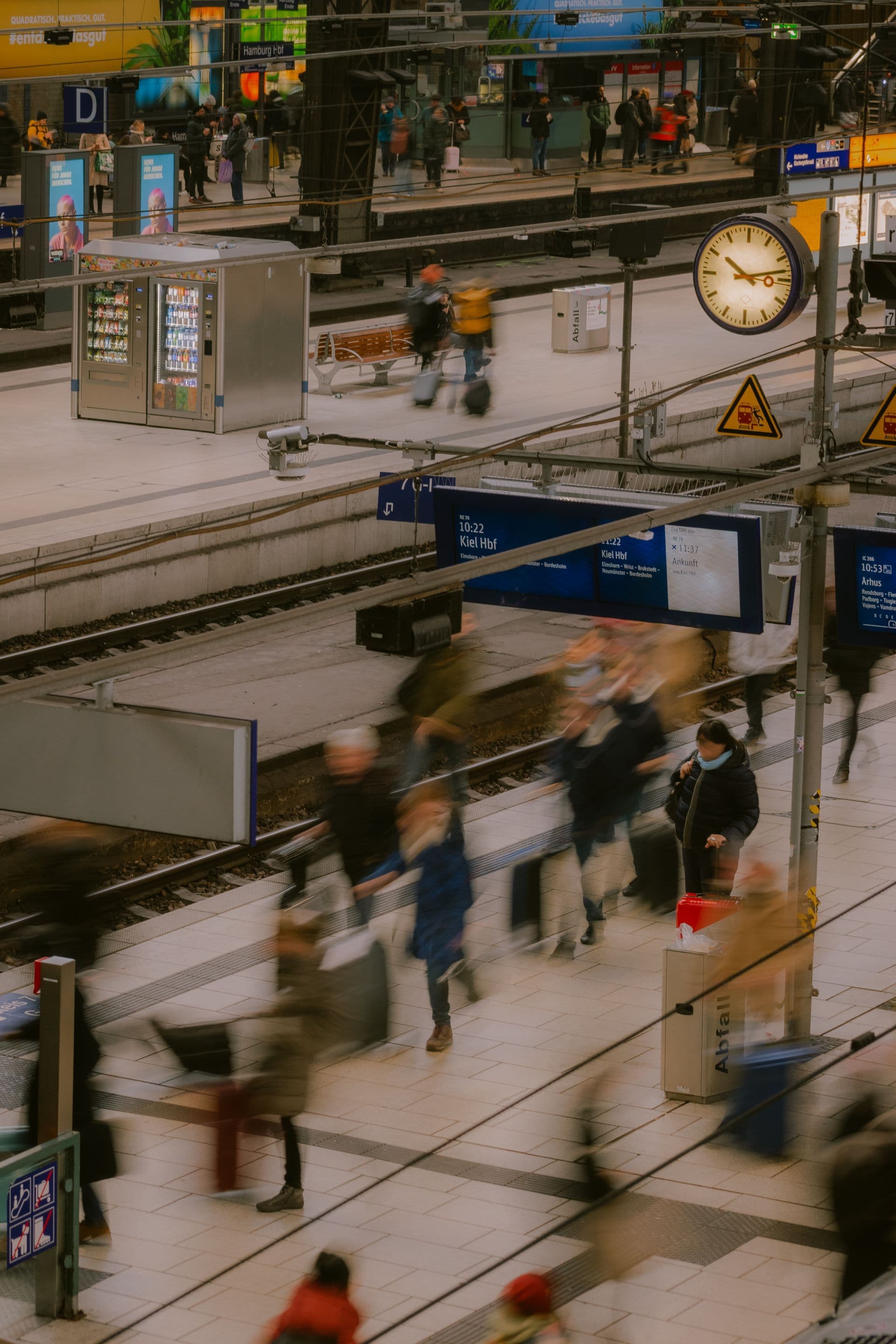
Conventional navigation tools lose accuracy inside busy train stations. For a leading Dutch rail operator, we built an indoor navigation prototype that used existing station infrastructure to guide travellers accurately across platforms and different floor levels.
How might we help travellers navigate complex train stations with the same confidence as they navigate outdoors?
Inform
Navigating where GPS falls short
Since the introduction of Google Maps, travellers have come to expect reliable navigation wherever they go. Inside large train stations, however, poor GPS signals make it difficult to determine someone’s exact location. Conventional navigation tools could therefore provide only an approximate position, leaving travellers without accurate guidance to the right platform or between different floor levels. Imagine travelling from Amsterdam to London with a transfer in Brussels. You need to find the right platform, move between multiple floors and pass through customs, all within a limited transfer time. Without accurate indoor navigation, a straightforward transfer can quickly become stressful.
Analyse
Using existing infrastructure to navigate indoors
To create a more accurate indoor navigation experience, we used existing station infrastructure in an environment where GPS was unreliable. Large train stations were already equipped with routers, and by using these networks for triangulation, it became possible to determine a traveller’s indoor location more accurately. Using Google Maps as a foundation, we mapped 1,365 metres of Amsterdam Central Station, including platforms, shops, lockers, corridors, elevators and gates, and connected this digital map to existing navigation software. The result was an indoor wayfinding service that could guide travellers between different floor levels, an unprecedented capability in the European market at the time. The project resulted in 310 training hours and laid the foundation for the prototype.
Activate
Bringing indoor navigation into the traveller journey
The outcome was a first-phase MVP extension to the rail operator’s traveller app. The prototype achieved an accuracy of one metre, enabling travellers to navigate stations and move between floor levels with greater precision than conventional routing. Compared with regular routing in train stations, the prototype increased customer satisfaction by 26%. It demonstrated that accurate indoor navigation could become a practical addition to the rail operator’s app, using existing infrastructure to create a smoother travel experience.
Results
- 1mPositioning accuracy achieved
- 26%Increase in customer satisfaction
- 1,365mMapped on stations
- 310Training hours invested